
Black Friday Do's and Don'ts for Small Businesses

Updated: Oct 14
Short answer: Black Friday 2026 is on 27 November. Small businesses do best when they keep it short (one day or one weekend), offer real value instead of deep discounts (gift sets, bundles, early access for loyal customers) and get stock, checkout and delivery ready in advance. In the EU, a discount must be measured against your lowest price in the 30 days before, so a “fake” discount isn’t only bad for trust. It’s also against the rules. And if Black Friday doesn’t fit your brand or your margins, skipping it is a valid choice. |
Black Friday Lost in Translation
Black Friday started in the United States as a single day of extraordinary retail discounts following Thanksgiving (celebrated on fourth Thursday in November). Its power has always been rooted in urgency: one day, limited stock, and a fear of missing out.
In Europe, however, the concept has often been diluted. Instead of a one-day shopping frenzy, we see “Black Week” or even “Black Month” campaigns. While this may seem like a clever way to extend sales, it undermines the original idea. If discounts are always available, urgency disappears – and so does much of the impact.
Europe stretched Black Friday so thin that one day of frenzy has turned into a whole week (or even a month) of discounts.
What changed in 2025? Shoppers started earlier. For the second year in a row, Black Friday online sales grew faster than Cyber Monday’s (Adobe). Shoppers also became pickier: average prices rose 6%, but the number of orders grew by only 2% (Salesforce). People are still buying, but they think harder about what’s worth it. That’s good news for small businesses that compete on value rather than price.
For small businesses, this is an opportunity. By approaching Black Friday strategically, without copying big retailers, you can create real buzz, boost sales, and strengthen your customer relationships. Let’s break down the do’s and don’ts that will help you get it right.
✅ Black Friday Do’s
1. Create Real Urgency
The essence of Black Friday is urgency. Keep your promotion short, ideally one day (or one weekend at most), and make it clear when the offer ends. Use countdown timers on your website, reminders in email campaigns, and social media stories that highlight the ticking clock.
2. Prepare Your Logistics in Advance
Nothing ruins a Black Friday campaign like stockouts, slow websites, or delivery delays. Small businesses should:
Audit stock levels well before launching.
Stress-test their website checkout process.
Align with shipping partners about delivery times.
If customers face technical hiccups, they won’t wait – they’ll go elsewhere.
3. Highlight Value, Not Just Discounts
Big retailers compete on slashing prices. Small businesses can’t and shouldn’t play that game. Instead, emphasize unique value:
Limited-edition products
Exclusive bundles
Free gifts with purchase
Priority access for loyal customers
People will happily pay a fair price if they see something special.
4. Test Your Campaign Before the Big Day
Run a smaller promotion in early November to test your messaging, email subject lines, or ad targeting. This way, you can adjust before the stakes are higher.
5. Communicate Clearly Across Channels
Promote your offer in advance via:
Email campaigns (teasers + launch + last call)
Social media (stories, reels, pinned posts)
Website banners or landing pages
Make sure all channels are consistent – confusion kills conversions.
❌ Black Friday Don’ts
1. Don’t Stretch It Into a Month
Calling every November discount “Black Friday” only trains customers to wait until the last minute for better deals. Keep it sharp, keep it short.
2. Don’t Offer Fake Discounts
Customers are savvy. If you mark up prices in October only to “slash” them in November, you’ll damage your reputation. Transparency builds trust; manipulation destroys it.
In the EU, it’s also a legal issue. Since 2022, under the EU rules on price reductions (the Omnibus Directive), any advertised discount must be measured against the lowest price you charged in the 30 days before the sale. For example, if your product was €100, then €80 three weeks ago, and now €70, you can’t call it “30% off”. The discount counts from €80. This applies to online and in-store sales across the EU, including Cyprus (K&L Gates). (This explains the rule, not legal advice. If you sell outside the EU or use loyalty discounts, check the local rules.) |
3. Don’t Overpromise and Underdeliver
Avoid exaggerated claims or discounts you can’t sustain. Nothing backfires faster than canceling orders or delaying shipments because you weren’t ready.
Customers are savvy. Transparency builds trust; manipulation destroys it.
4. Don’t Copy Big-Box Retailers
You don’t have their margins or supply chain. Competing purely on discount percentages is a losing game. Instead, lean into your agility and personal touch.
5. Don’t Forget About Customer Experience
Black Friday shouldn’t only be about quick sales. Think long-term: how will you convert these one-time buyers into repeat customers? Add handwritten notes, loyalty coupons, or a follow-up email to build relationships.
Your Black Friday countdown
6 weeks before (mid-October): Decide your goal (clear stock, bring in cash or win new customers) and choose one offer. Check stock levels and confirm delivery times with your courier.
4 weeks before (end of October): Build your landing page or banner. Prepare emails and social posts. Test checkout on your phone.
2–3 weeks before (early November): Run a small test offer to try your subject lines and messages.
Week of Black Friday: Send teasers. Give subscribers early access on Thursday evening.
Black Friday (27 Nov): Launch email in the morning, reminder in the afternoon, last call with a countdown in the evening.
Within 48 hours after: Send a thank-you email with a small perk to bring buyers back in December. Then link readers to your Cyber Monday post.
Add handwritten notes, loyalty coupons, or a follow-up email to build relationships.
Examples of Black Friday Done Right
Local boutique: Instead of “50% off everything,” they offered a limited-edition holiday gift set with only 50 available. Sold out in hours.
Online course creator: Bundled their top three workshops into one discounted package. Revenue tripled compared to normal months.
Eco-friendly shop: Offered discounts only on sustainable products while spotlighting their mission. Customers loved the alignment with values.
Conclusion: Quality Over Quantity
Black Friday can be overwhelming, especially for small businesses watching giant retailers dominate the headlines. But remember: success doesn’t come from endless discounts or noisy campaigns. It comes from clarity, authenticity, and urgency.
In 2026, resist the temptation to stretch Black Friday into a week-long marathon. Focus on delivering one powerful, well-executed campaign – your customers (and your bottom line) will thank you.
It's ok to say NO
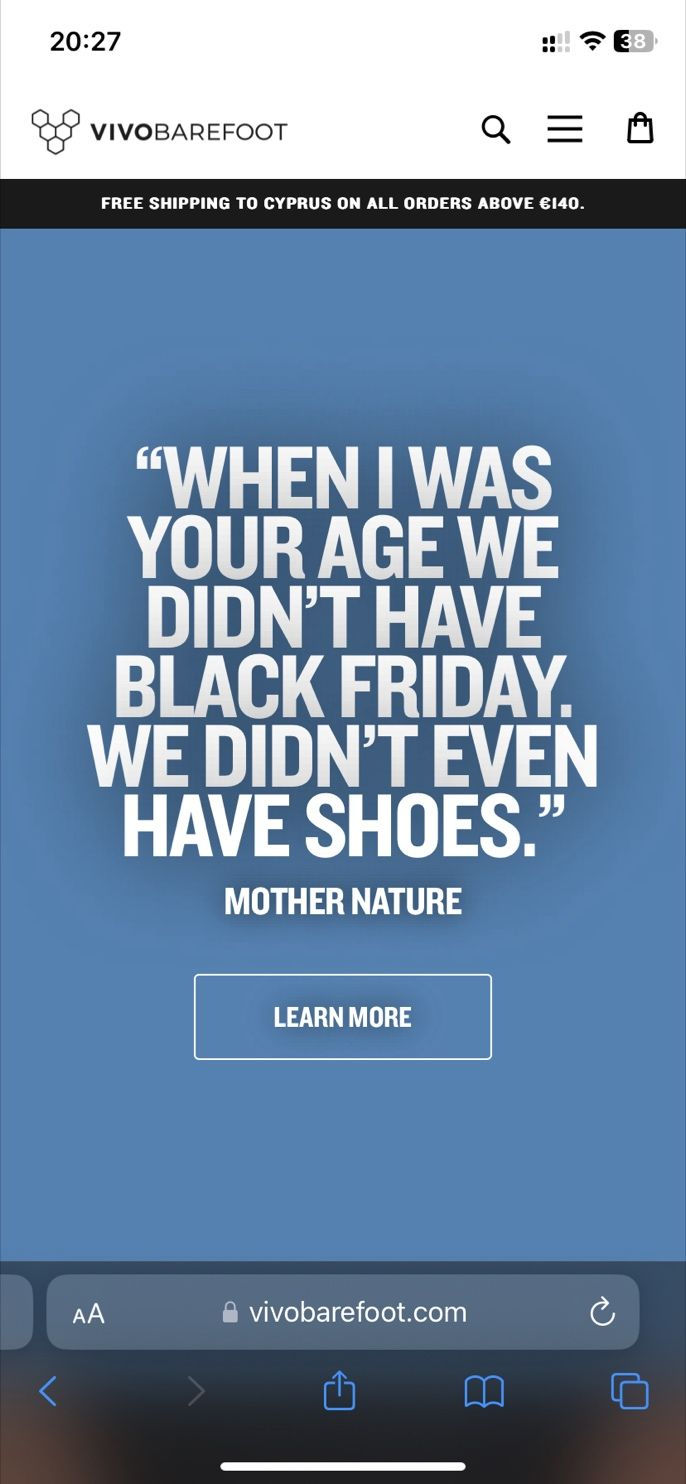
Sometimes skipping Black Friday is the right call for your values and your margins. Vivobarefoot made the point brilliantly in 2024 with its “When I was your age we didn’t have Black Friday. We didn’t even have shoes” campaign. In 2025, though, they ran a sale of up to 30% off selected models. That isn’t hypocrisy. It shows that even values-led brands review the decision every year based on their goals and stock.
Do the same: decide every year, on purpose, instead of joining in by default. (And yes, I was still hoping for a discount on my favourite pair.)
FAQ
When is Black Friday 2026?
Friday 27 November 2026, the day after US Thanksgiving. Cyber Monday follows on 30 November.
Should a small business take part in Black Friday?
Only if you have a clear goal and the margins for it, such as clearing old stock or bringing in cash before December. If discounts would hurt your brand or your profit, it’s fine to skip it or to reward loyal customers quietly instead.
How long should a Black Friday sale last?
One day, or one weekend at most. The longer it runs, the less urgent it feels, and customers learn to wait for discounts.
What can I offer instead of a big discount?
Limited-edition gift sets, bundles, a free gift with purchase, free shipping or early access for subscribers. All of these protect your margin better than cutting prices.
Can I raise prices before Black Friday and then discount them?
No. Under EU rules, a discount must be measured against your lowest price in the 30 days before the sale. Besides the legal risk, customers notice, and it damages their trust.
What’s the difference between Black Friday and Cyber Monday?
Black Friday began as an in-store event and Cyber Monday as its online version. Today they overlap, but you can use Black Friday for your main offer and Cyber Monday for a last online-only push.
I'm Tereza – I help founders stop being the marketing department and start having one.
Sources:


Comments